
Home / Why Quantlyx
One platform, one register, every actor in your lifecycle
Quantlyx connects to the systems you already run, builds a single register of everyone and everything that touches your software, and keeps it current. It is a product you deploy, not a review you commission.
What the platform does
Read-only connectors
Source control, continuous integration, artefact registry, deployment, access governance, the privileged access platform and secret stores.
One actor register
People, service accounts, build identities, release bots and coding agents resolved into one entry each, however many systems name them differently.
Difference detection
Only the lines where the approval record and the lifecycle event disagree. No score theatre, no queue of things you already knew.
Evidence on every finding
Each difference carries the commit, build, deployment or checkout that produced it, with the source record identifier, ready for an auditor.
Owner routing and closure
Every finding lands with the accountable human, not a shared mailbox, and the platform tracks whether it closed or aged past its window.
Scheduled or on-demand runs
Run it fortnightly against the whole estate, or on demand before a release board, an audit window or a regulatory examination.
Guided remediation
Each finding carries a proposed action — revoke, rotate, recertify or re-scope — routed to the accountable owner with the evidence attached.
Timely deprovisioning
Standing access nobody uses, and access that outlived its ticket, surface while the window to remove them is still open.
Highest-risk recertification
Reviews start with the entitlements ranked by risk, each with a plain-language definition, so campaigns stop being rubber-stamped.
Four steps, in order, on a fortnightly cycle
Quantlyx runs inside your environment with read-only credentials to the systems you already operate.
Collect
Pull the current state from both sides: the approval and entitlement records, and the lifecycle systems that hold the actual events.
Reconcile
Resolve one actor across systems that name it differently — a person, a service account and a bot token that are all the same principal.
Detect
Raise only the differences: who acted, under what authority, and whether it was ever approved.
Govern
Route each difference to the accountable owner with the evidence attached, and track whether it closed.
Reconciliation, one actor and one stage per line
Lines that reconcile are shown too, so you can see Quantlyx is not crying wolf. Only the lines where the two registers disagree are raised as findings.
| Actor | Kind | Stage | Approved as | Actually recorded | State |
|---|---|---|---|---|---|
| j.okafor | Person | code | Reviewer on ticket CHG-4412 | Approved and merged the change | reconciled |
| assistant-commit | Coding agent | code | No record | Authored 63 merged commits this month | difference raised |
| ci-runner-prod | Build identity | build | Certified, owner Platform | Signed artefacts, owner matches | reconciled |
| deploy-bot-eu | Release bot | deploy | Revoked 12 Aug | Deployed to production 2 Sep | difference raised |
| r.mehta | Person | deploy | Release approver, change window only | 4 out-of-window releases | difference raised |
| artifact-promoter | Service | build | Certified, exempt from review | Promotions match the record | reconciled |
| vendor-scan-svc | Service | run | Owner left the organisation 3 Jun | Pipeline still runs daily | difference raised |
Sample output. Your own run is against your systems of record.
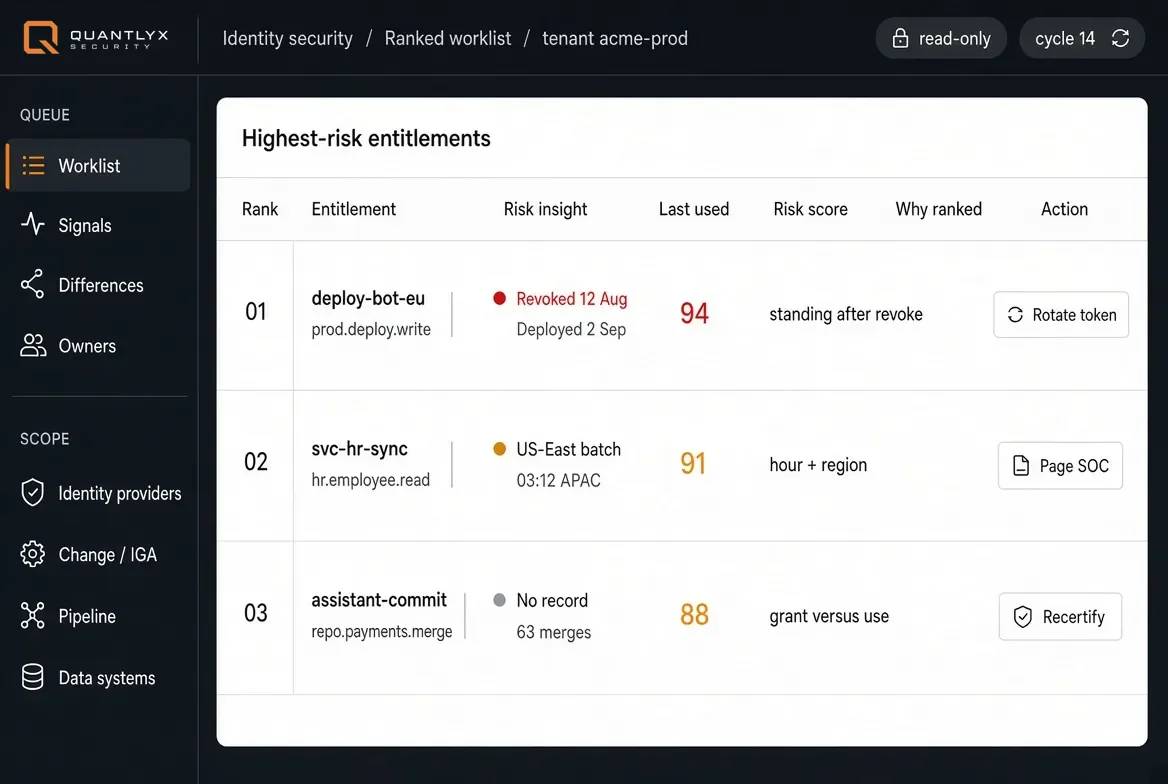
Highest-risk first. Definition attached.
An entitlement the owner cannot explain is not a control. Quantlyx ranks by risk and carries a plain-language definition with the finding.
| Rank | Principal | Approved as | Actually used | Signal | Action |
|---|---|---|---|---|---|
| 01 | deploy-bot-euRelease bot · prod.deploy.write | Revoked 12 Aug · CHG-881 | Deployed to production 2 Sep | standing after revoke | Rotate token |
| 02 | svc-hr-syncService account · hr.employee.read | US-East · 01:00–04:00 batch | 03:12 from APAC · ad-hoc query | hour and region | Page the operations desk |
| 03 | assistant-commitCoding agent · repo.payments.merge | No governance record | 63 merged commits this month | grant versus use | Recertify |
| 04 | vendor-scan-svcService · registry.pull | Owner left 3 Jun | Pipeline still runs daily | standing after reason died | Assign owner |
| 05 | snowflake-analyst-poolRole · finance.payouts.select | 42 seats certified | 11 exercised in 90 days | license waste | Recover seats |
Illustrative worklist. A pilot replaces these lines with your actors, evidence and owners. Quantlyx ranks; the access platform you already run carries out the change.
Remediation that starts with evidence
The reconciliation core stays read-only, then puts a proposed action in front of a named owner. Nothing is revoked automatically.
Propose
Revoke the standing grant, rotate the token, recertify the entitlement, or re-scope the service account to the ticket that created it.
Approve
The accountable human signs the action. The gate cannot be skipped. Discovery and response never share a write credential.
Execute
Your existing governance, privileged access or identity provider carries out the change. Quantlyx does not write back into the pipeline.
Confirm
The next reconciliation run either closes the difference or keeps it open with fresh evidence.
Read-only is the product decision, not a limitation
Quantlyx sits inside your environment and pulls. It has no path back into a pipeline, no credential that can change anything, and no route out of your tenant. That is what makes it deployable in a regulated estate in a fortnight rather than a year.
- Runs in your tenant
- Read-only credentials
- No agents on hosts
- No source code read or stored
- Fortnightly or on demand
Your lifecycle systems
Quantlyx, inside your tenant
Outputs, still inside the tenant
What Quantlyx is not
Not a scanner
Quantlyx does not read your code, look for vulnerabilities or rate your dependencies. Keep the tooling you have for that.
Not a gate
It never blocks a build, a merge or a release. The reconciliation core has no write access, so it cannot break a pipeline at two in the morning, and QuantQFix acts only when a person approves, never on a release path.
Not another identity store
It holds no entitlements and grants no access. Your access governance platform stays the system of record.
The platform ends in a ranked worklist from the NHI misuse threat library: the finding, the evidence, an owner, and a fix a person approves. The platform ends in identity threat remediation.
ID entitlement. Rank by risk. Remediate.
Start with a two-week, read-only pilot against one lifecycle path. If nothing turns up, you keep a clean report.