
Home / Products / Access management
Access management and security
The identity provider remains the source of truth for who can log in. Quantlyx Access sits on top — vaulting, session control, credential rotation and least privilege for humans, machines and AI agents. SAML and SCIM to your identity provider. Zero-knowledge encryption. Overlay or stand-alone.
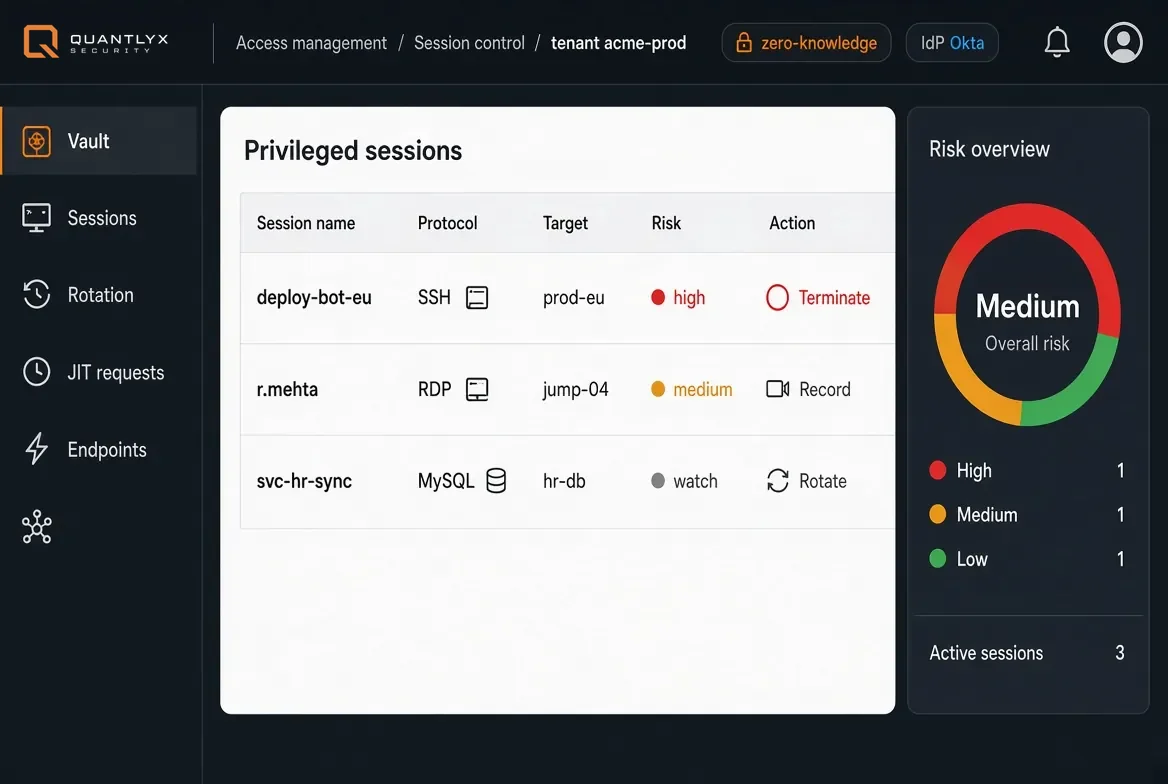
Privileged sessions · SSH, RDP, database · risk on the line · terminate, record or rotate.
Capabilities
Control plane, not another directory
Authenticate through the identity provider you already run. Groups and attributes sync. Conditional access and multi-factor authentication stay where they are.
Vault, rotate, watch the session
Credentials, secrets and remote connections under one policy. Auto-rotate. Analyse the session. Terminate high-risk activity.
Humans, machines, AI agents
One policy engine. Service accounts and coding agents are first-class principals, not an afterthought in the vault.
Overlay where a vault already exists
Keep the existing privileged store on the most regulated systems. Extend coverage to cloud, DevOps and third-party access.
Zero-knowledge model
Encryption and decryption on the client. Nothing usable sits on Quantlyx servers if the tenant is copied.
Assets SSO does not reach
SSH, RDP, databases and internal tools that never spoke SAML. Vaulted, audited access without a second password store for the user.
The identity provider answers who can log in. Quantlyx answers what happens after that.
Access management controls the identity once the NHI misuse threat library has flagged how it is being used. This is where identity threat remediation reaches the live session.
ID entitlement. Rank by risk. Remediate.
Start with a two-week, read-only pilot against one lifecycle path. If nothing turns up, you keep a clean report.