
Home / Solutions / Security operations
NHI misuse signals for the SOC
Quantlyx gives a security operations center NHI misuse detection built on named access patterns: off-purpose use, odd hour and region, and standing access after revoke. Each signal arrives with its evidence and a proposed response, so the desk is paged for the line that looks like misuse and not for the whole catalogue.
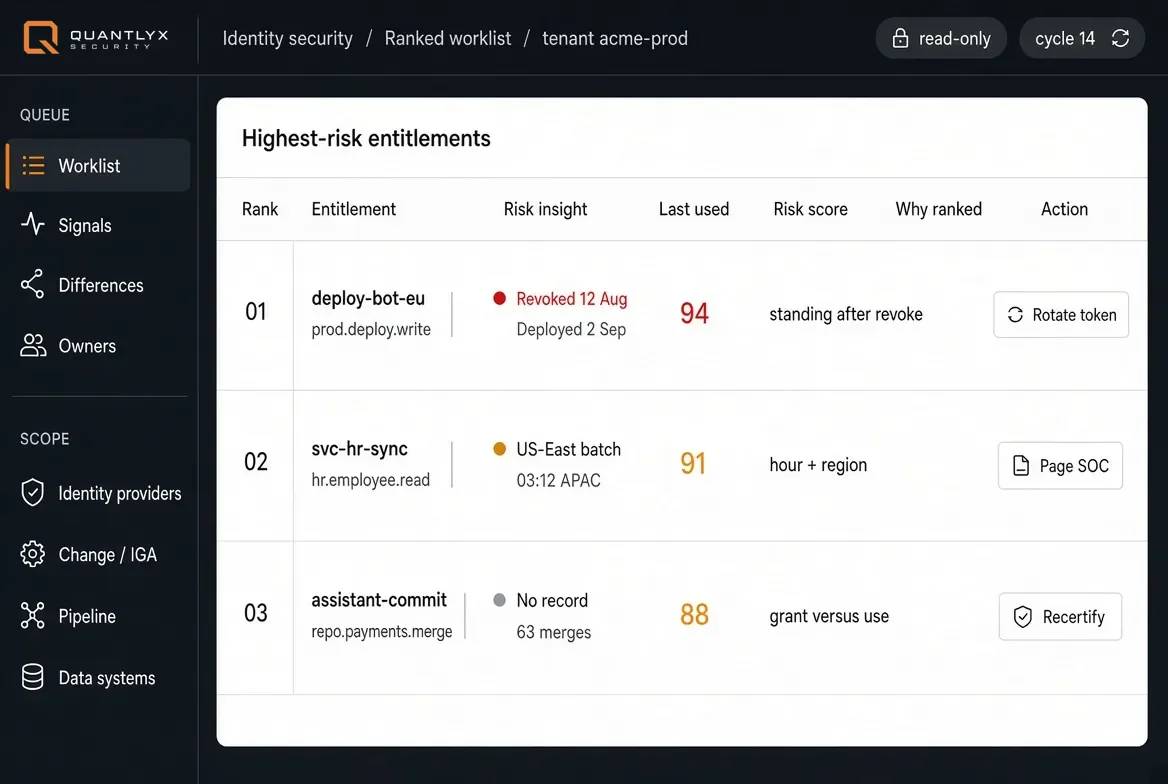
A signal, not another feed. Only the needle pages the desk.
What the SOC gets from NHI misuse detection
Named signals, evidence attached
Access-pattern detection raises named patterns with the evidence in the finding. The operations team is not asked to read the catalogue.
A ranked worklist
Recertify, rotate, recover or assign an owner. The highest-risk lines come first.
The needle in the haystack
Most identity estates produce more entitlements than any team can read. Only the line that looks like misuse pages the desk.
Non-human identities included
Service accounts, release bots and coding agents are on the same register. Owner gone, grant live is a named library entry.
Remediation with approval
QuantQFix proposes a playbook per finding. A person approves each write action, and the case closes only when the source system shows the change.
Session control
Access management can analyse a privileged session and terminate high-risk activity, so a compromised account does not keep working while the ticket waits.
The thirty-minute demo for this role
The session runs against sample data and stays on the lines that matter to the person in the room.
Library to page
- 0–8Three patterns: off-purpose, odd hour and region, standing after revoke.
- 8–20The 03:00 HR query and the revoked-but-live deploy bot, evidence attached.
- 20–30What pages the desk, and what never should.
Detect the standing grant. Control the session. Expire the access.
ID entitlement. Rank by risk. Remediate.
Start with a two-week, read-only pilot against one lifecycle path. If nothing turns up, you keep a clean report.