
Home / AI agent governance
What is AI agent governance?
AI agent governance, also called agentic AI governance, is the set of policies, ownership rules and records that decide which AI agents may act in your systems, what they can reach, and who is accountable for what they do. Unlike governing a model, it has to cover actions, because an agent acts. It starts with identity: you cannot govern an agent you have not found, or cannot tell from a person.
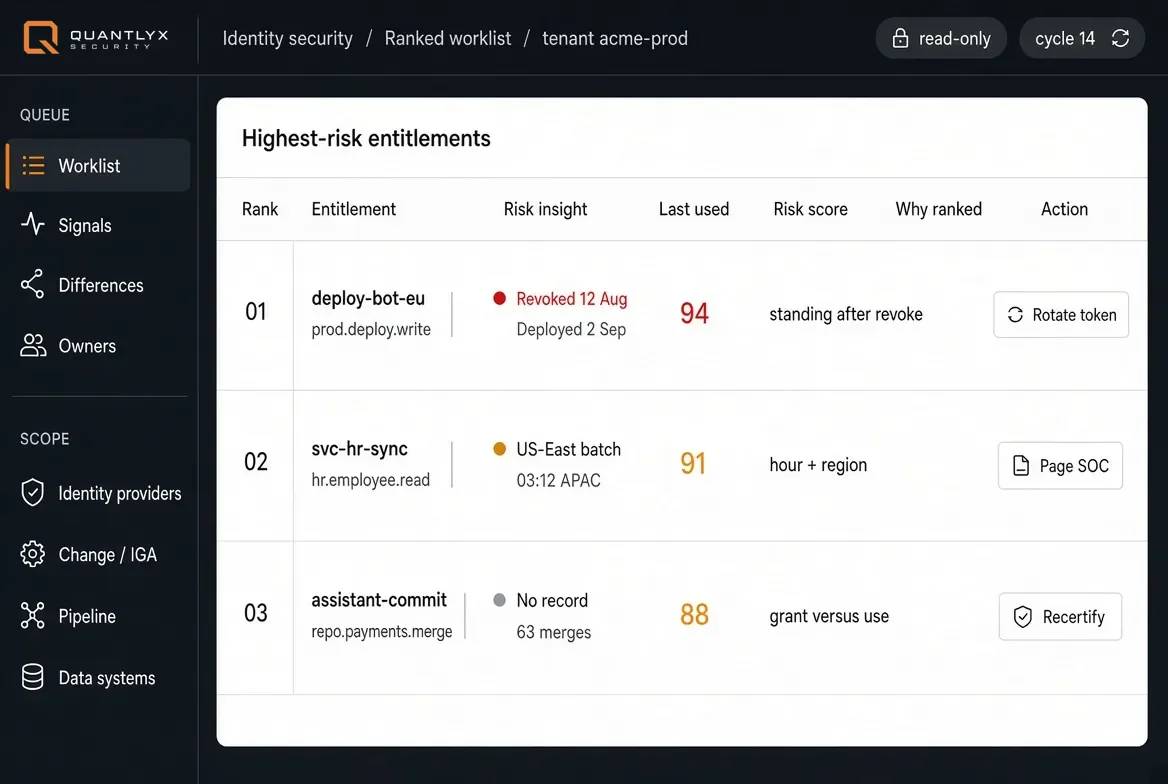
Ranked worklist on a sample tenant. A pilot shows your own identities and evidence.
Why agents need their own governance
Governance built for people assumes a login with a person behind it. Governance built for models assumes an output a person reviews. An agent is neither: it acts on its own, continuously, with the access it was given.
Instructions and data blur
An agent reads text and acts on it, so what it reads can steer what it does. The line between what it is told to do and what it merely reads is thinner than it is for a conventional program.
A confused agent can misuse real access
Every agent added is another place where access granted for one purpose can be used for another, on behalf of someone who never approved it.
Credentials sprawl
Agents often get their keys from environment variables, hard-coded configuration or secrets pasted into a pipeline, where identity tooling rarely looks.
A governance framework in four parts
Four parts cover the identity side of agent governance. Each answers a question a security or compliance lead will be asked.
1. Know every agent
You cannot govern what you cannot see. Find the coding assistants, service accounts and autonomous agents that already hold access, across source control, CI/CD, secrets management and your identity provider, without waiting for anyone to register them.
2. Know what each one is, and who owns it
Tell an AI agent from a person using real signals, not a naming convention, and record an accountable owner for each, or the fact that it has none.
3. Keep a record of what it did
Attribute every commit, pull request and access event to a verified identity, so the record answers who or what acted, not only which account.
4. Decide the response by risk
Not every response deserves the same amount of automation. Routine policy actions can run on their own, contained and reversible steps can start on a high-confidence signal with a reviewer told at once, and anything permanent waits for a person.
Runtime guardrails, which check or block an agent's tool call as it happens, are a further part of agent governance that other tools provide. This page covers the identity side, because a rule, an owner or an audit trail needs an identified agent to attach to.
A checklist for this week
You can start without buying anything.
- List every AI agent, coding assistant and service account that can reach your source control, pipelines or secrets.
- Name an accountable owner for each, or mark it as having none.
- Record what each one is: a person, an AI agent or a shared account.
- Find credentials kept in environment variables, configuration files or pipeline secrets, and note which agent uses each.
- Compare what each agent can reach with what it actually does.
- Decide which actions may run on policy alone, which need a reviewer told at once, and which need a person to confirm.
- Keep the record somewhere you can query when someone asks what an agent did.
- Repeat on a schedule. Agents appear without announcement, and their behaviour can change when a model or a prompt does.
Shadow AI: finding the agents nobody registered
Shadow AI is access that exists whether or not anyone approved it: a coding assistant with commit access, a service account calling an internal API, an agent that fetches credentials on a schedule. None was provisioned through the process built for people, so none appears on a register.
The way to find them is to read where they act, in source control, CI/CD, secrets management and your identity provider, with read-only access, and list what exists. Then give each one an owner.
How Quantlyx approaches it
Quantlyx covers the identity side of governance. It reads source control, CI/CD, secrets management and identity providers with read-only credentials, and finds human, AI agent and service-account identities that already exist, without anyone registering them first.
Say what each one is
Each identity is classified as a person or an AI agent from real signals in its source system. Where the signal is weak, the identity is marked for review and the weakness stays in the record.
Tie actions to an owner
Commits, pull requests and access events are attributed to a verified identity, not only to an account name that a person and the agent acting for them might share.
Size the response
Pre-agreed policy actions run on their own, contained and reversible steps are reported to a reviewer at once, and anything permanent waits for a person.
It does not replace your identity provider, your governance tool or the guardrails that check an agent's tool calls. See AI agent identity security and identity threat remediation.
AI agent governance: common questions
What is AI agent governance?
AI agent governance, also called agentic AI governance, is the set of policies, ownership rules and records that decide which AI agents may act in your systems, what they can reach, and who is accountable for what they do. It covers actions as well as outputs, because an agent acts.
How is AI agent governance different from AI model governance?
Model governance is mostly about what a model produces and the data behind it, with a person reviewing the output. Agent governance has to deal with what an agent does: which systems it can reach, whose behalf it acts on, and who answers for it. That makes identity, ownership and an audit record the starting point.
What is an AI agent governance framework?
It is a set of practices that answer four questions for every agent: do we know it exists, do we know what it is and who owns it, do we have a record of what it did, and have we decided how to respond when something changes. The four parts above are one way to organise them.
Is there a single standard framework for AI agent governance?
There is no single agreed framework specific to agents that every team follows. Many teams start from broader AI risk frameworks, such as the NIST AI Risk Management Framework and ISO/IEC 42001, and add controls for agent identity, access and audit.
Who should own an AI agent?
A named person or team accountable for what the agent does, usually whoever requested or deployed it. Record that owner against the agent. If no owner can be named, that is a finding: the agent has access that nobody answers for.
What is shadow AI, and how do you find it?
Shadow AI is access held by agents that nobody approved or registered. You find it by reading the systems where agents act, source control, CI/CD, secrets management and identity providers, rather than by waiting for teams to declare what they run.
Does every agent action need a person to approve it?
No. Not every response deserves the same amount of automation. Routine policy actions, such as scheduled credential rotation, can run on their own, and contained, reversible steps can start on a high-confidence signal with a reviewer told at once. Anything permanent, such as revoking a credential or disabling an account, should wait for a person.
See which AI agents hold access in your environment
Read-only pilot. One lifecycle path. If nothing turns up, you keep a clean report.