
Home / AI agent identity security
AI agent identity security
AI agent identity security is knowing which AI agents hold access in your environment, proving what each one is, and tying everything it does to an owner. AI agent governance starts there: you cannot govern what you cannot see. Agents act continuously, inherit whatever access was convenient to grant, and are rarely registered anywhere a security team looks. Quantlyx finds them by reading, and a person decides anything that cannot be undone.
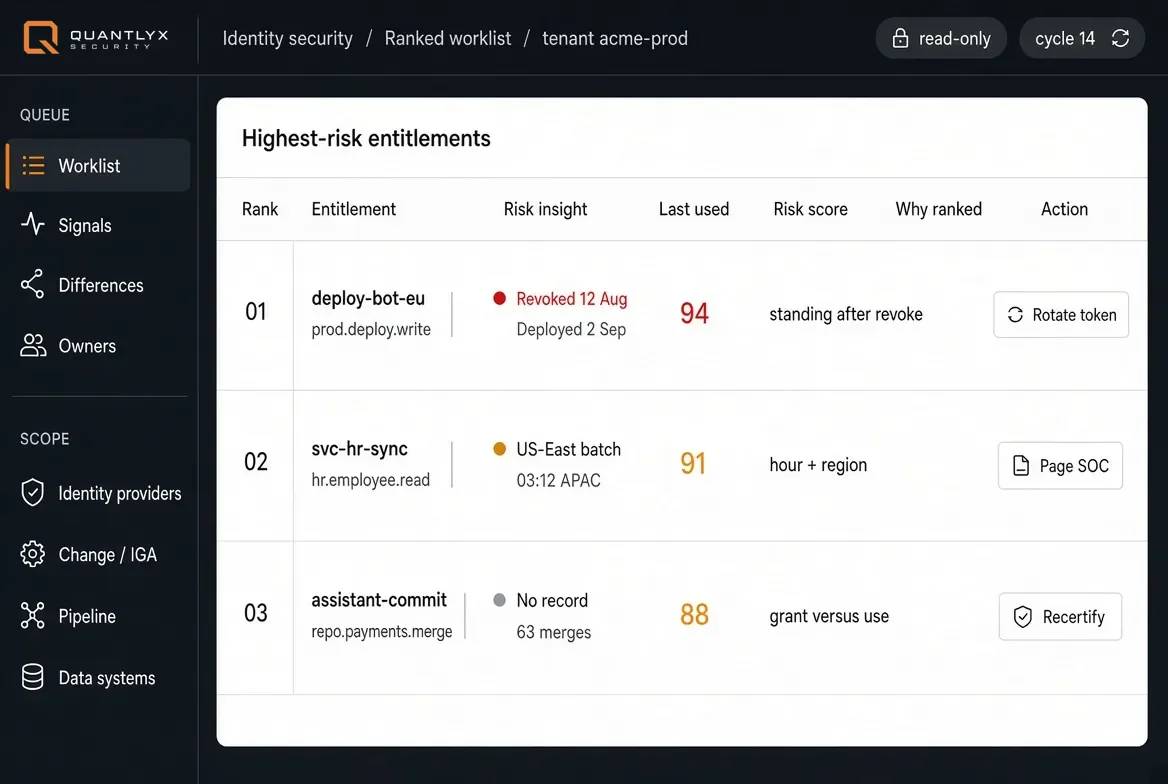
Ranked worklist on a sample tenant. A pilot shows your own identities and evidence.
Why agents break the old identity model
Identity and access management assumed a person behind every login. An AI agent is not a person with a different avatar, and it is not a service account that never changes behaviour.
Access nobody approved
Coding assistants with commit access, service accounts calling internal APIs and agents that fetch credentials on a schedule were never provisioned through the process built for people. Call it shadow AI: access that exists whether or not anyone approved it.
Behaviour that can change overnight
A person's access review assumes they act the same way next week. An agent's behaviour can shift the moment its model or prompt changes.
One agent can steer another
A low-privilege agent can induce a higher-privilege one to take an action that no person and no static policy authorised.
Credentials in the wrong places
Agents often get their keys from environment variables, hard-coded configuration or secrets pasted into a pipeline, where identity tooling rarely looks.
What Quantlyx does about it
Quantlyx reads source control, CI/CD, secrets management and identity providers with read-only credentials, and finds human, AI agent and service-account identities that already exist, without anyone registering them first.
Say what each one is
Each identity is classified as a person or an AI agent from real signals in its source system, not from a name or a naming convention. Where the signal is weak, the identity is marked for review and the weakness stays in the record.
Tie actions to an owner
Commits, pull requests and access events are attributed to a verified identity, not only to an account name that a person and the agent acting for them might share.
Flag what changed
Real access and authentication events are compared with each identity's own baseline. The signals are specific and explainable: activity far above its norm, access at an unusual hour, a credential used past its rotation window, two agents passing vault access with no person involved.
Rank by risk, with the evidence
Each finding goes to the accountable owner with the evidence attached, ranked on the same NHI misuse threat library as every other non-human identity.
How response is sized
Not every response deserves the same amount of automation. Quantlyx sizes it to how reversible the action is, and discovery is read-only. A person decides anything permanent.
Pre-agreed policy actions
Scheduled credential rotation, expiry of a time-boxed grant and session timeout run on their own. No detection is involved: they are a clock and a policy.
Contained, reversible steps
A step-up challenge, temporary read-only access or a session quarantine can start on a high-confidence signal, with a reviewer told at once.
Anything permanent
Revoking a credential or disabling an account waits for a person to confirm it, however confident the signal looks.
See identity threat remediation for how each tier works.
What a pilot reads
A pilot connects read-only to one lifecycle path for two weeks and lists the AI agents and other non-human identities it finds, with an owner, or the lack of one, for each. If nothing turns up, you keep a clean report.
AI agent identity security: common questions
What is AI agent identity security?
AI agent identity security is knowing which AI agents hold access in your environment, proving what each one is, and tying what it does to an owner. It starts with finding the agents nobody registered, because most organisations already have a population of them: coding assistants with commit access, service accounts calling internal APIs and agents that fetch credentials on a schedule.
Is an AI agent a non-human identity?
Yes. An AI agent is a non-human identity that can act on its own, change behaviour when its model or prompt changes, and invoke other agents. It belongs on the same register as service accounts and build identities, with an owner and a record of what it did. See non-human identity security.
How secure are AI agents?
Less secure than most organisations assume, by default. Agents typically inherit whatever access was convenient to grant during setup, run continuously without the re-authentication a person's session has, and often hold credentials that no security team reviewed because nobody was tracking that the agent existed.
How do I secure AI agent access?
Treat an agent's access like a highly privileged, always-on service account. Find every agent and service account that already holds access, confirm what each one is rather than trusting a name, watch for the behaviours that show something has changed, and keep a person in the loop for anything that cannot be undone.
How is this different from IAM and IGA?
Identity and access management (IAM) authenticates identities and enforces access decisions in real time. Identity governance and administration (IGA) reviews who has access, certifies it and keeps an auditable record. Most of both were built for the life of an employee, hire, role change and leave, and have no concept of an agent's lifecycle. Quantlyx sits beside them: it does not replace your identity provider or your governance tool.
Does Quantlyx block or revoke an agent's access?
Discovery is read-only. Quantlyx can take pre-agreed policy actions on its own, such as scheduled credential rotation or expiry of a time-boxed grant, and contained, reversible steps on a high-confidence signal, with a reviewer told at once. Anything permanent, such as revoking a credential or disabling an account, waits for a person. See identity threat remediation.
What would a pilot read?
A pilot connects read-only to one lifecycle path for two weeks and lists the AI agents and other non-human identities it finds, with an owner, or the lack of one, for each. If nothing turns up, you keep a clean report.
See which AI agents hold access in your environment
Read-only pilot. One lifecycle path. If nothing turns up, you keep a clean report.